
The Empress's Institutions of Knowledge
The Blazing WorldThis flow traces the Empress's attempt to organize inquiry by assigning different disciplines to the world's diverse peoples.
increasing Bearing strength in each event
 decreasing
Bearing strength in each eventdecreasingA Program of Inquiry
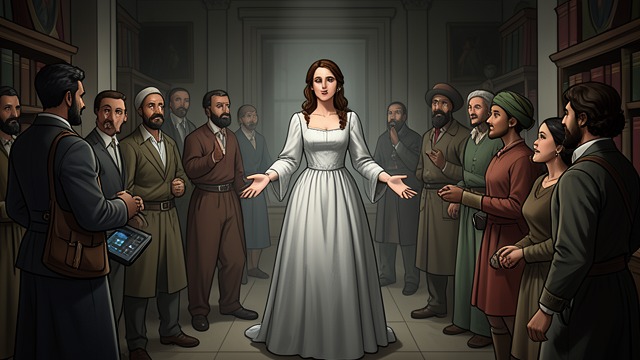
A Program of Inquiry
Curiosity Directed
The Empress summons her subjects and asks how their societies, religions, and professions work.
Knowledge as Government
Her questioning turns sovereignty into a program of investigation, with learned activity encouraged through organized communities.
Specialized Societies

Specialized Societies
Assigning Disciplines
The Empress places Bear-men in experimental philosophy, Bird-men in astronomy, and other peoples in natural philosophy, chemistry, medicine, mathematics, and rhetoric.
An Ordered Scheme
Professional identities become tied to species, giving the court a strikingly systematic but potentially restrictive model of learning.
Public Reports
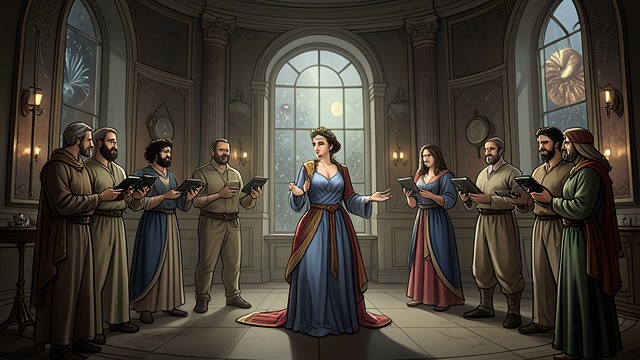
Public Reports
Knowledge Presented
The Empress calls learned groups before her to explain celestial bodies, weather, sea life, minerals, and medicine.
Authority Tested
Her questions expose disagreements among specialists and make clear that a learned title does not guarantee a settled account of nature.
Limits of Experiment

Limits of Experiment
Disagreement Persists
Reports on natural causes repeatedly conflict, and instruments sometimes multiply competing interpretations instead of resolving them.
A Cautious Lesson
The Empress learns that inquiry can produce useful observations without delivering certainty, and that institutional prestige is no substitute for judgment.
Knowledge Under Order
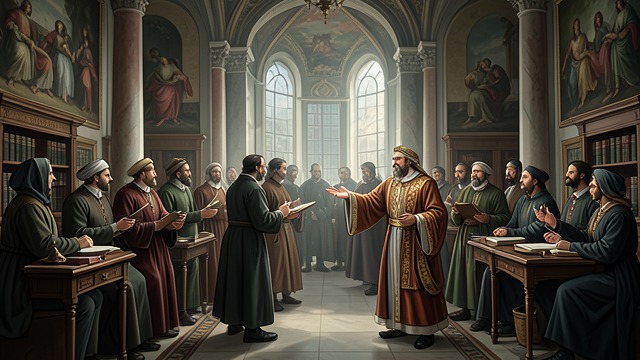
Knowledge Under Order
Learning and Stability
The Empress tolerates scholarly contention while trying to prevent it from escaping the schools and disturbing the state.
A Persistent Tension
Her institutions cultivate discovery, yet her preference for political harmony sets boundaries on how freely their disagreements may spread.
Early in the Empress's reign
After the first court inquiries
During the societies' first convocations
After the first series of investigations
By the later court debates
